By The SG Events Hub Team | Last updated June 2026
The first time someone told me Singapore was "changing fast," I nodded politely and didn't really think much of it. That was three years ago. Now, halfway through 2026, I genuinely think they were underselling it.
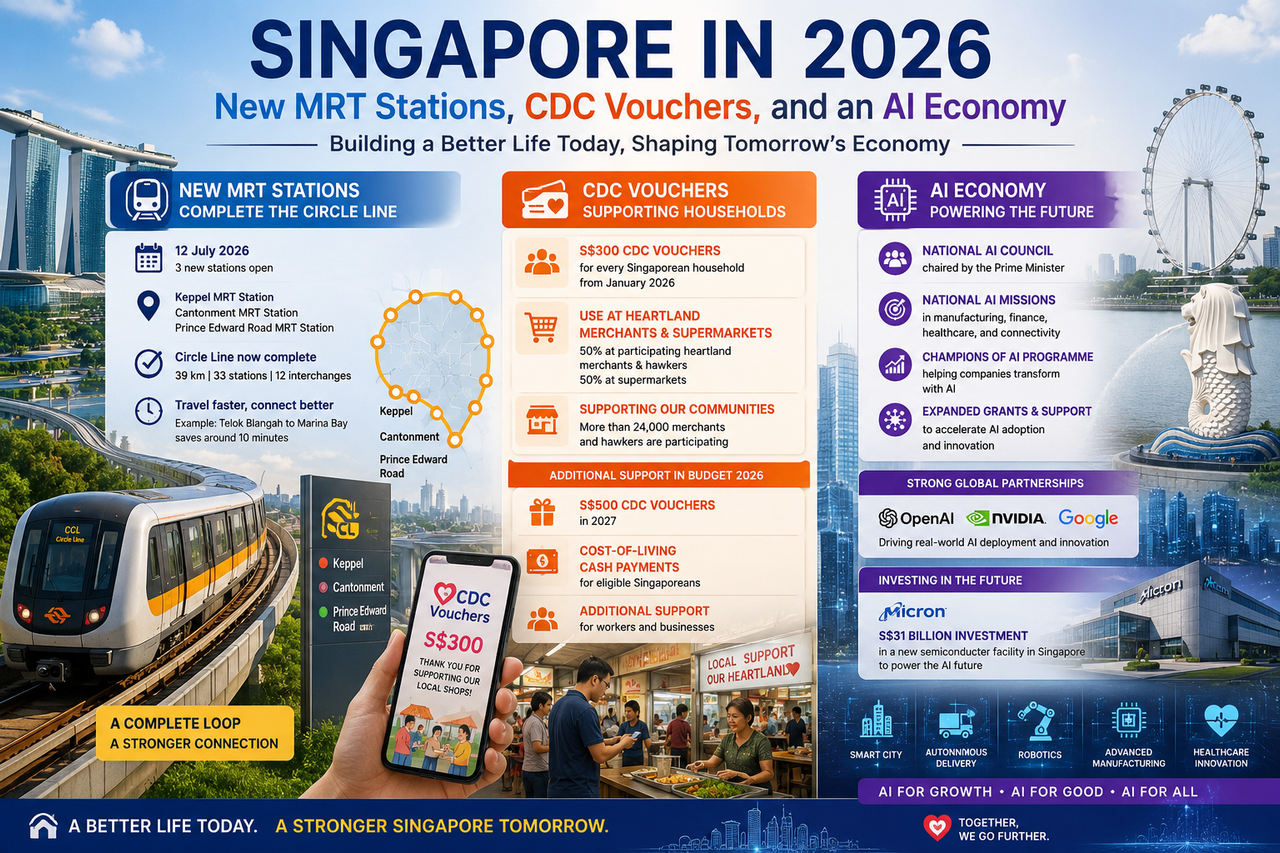
Three things are happening at once right now — and they're not happening quietly. The Circle Line is about to complete its loop for the first time in its entire history. Every Singaporean household can claim S$300 in CDC Vouchers to offset daily costs. And the Singapore economy — against the grain of a wobbly global backdrop — is still being propped up by an AI investment wave that shows no real signs of fading.
On their own, any one of these would be worth knowing about. Together, they paint a pretty specific picture of what Singapore actually looks like to live in, spend time in, and plan around right now. Here's the practical breakdown: what's happening, why it matters, and what it means for you on the ground.
The Circle Line Is Finally a Circle — And That Changes More Than You Think
Here's the thing about Singapore's Circle Line that most people outside of transport-nerd circles don't know: it's never actually been a circle. Since it opened in 2009, there's been a gap — a missing stretch between HarbourFront and Marina Bay — that meant you had to backtrack or transfer to connect those two sides of the city.
That gap closes on 4 July 2026.
The Land Transport Authority confirmed that Circle Line Stage 6 (CCL6) will open for a public preview on 4 July, adding three brand new stations: Keppel, Cantonment, and Prince Edward Road. Once they open, the Circle Line becomes what it was always supposed to be — a genuine loop, connecting HarbourFront all the way around to Marina Bay in both directions, with 12 interchange stations linking it to every other MRT line in the network.
What does this mean practically?
If you've ever tried to get from the southern waterfront — the Keppel area, Tanjong Pagar, the harbour side — to Chinatown or City Hall without driving or doing a two-transfer shuffle, you'll feel this immediately. Keppel and Cantonment stations serve a part of Singapore that has been genuinely underserved by public transport for years. That changes now.
For event-goers and visitors, it also means the southern precinct — one of the most interesting parts of Singapore for food, nightlife, and the arts — suddenly has direct MRT access. Venues, hawkers, and spots in that corridor that were always "a bit of a pain to get to" now aren't.
The bigger rail picture
Beyond CCL6, Singapore is still mid-expansion. The Cross Island Line (CRL) — which will be the longest fully underground MRT line in Singapore at over 50 kilometres — is actively under construction. The North-South Line is adding Brickland and Sungei Kadut stations. Two entirely new lines — Tengah and Seletar — are under study.
The long game is a Singapore where eight in ten households are within ten minutes' walk of an MRT station. That's not just a transport policy. That's a city design philosophy, and 2026 is one of the more concrete years of progress towards it.
What to do with this information: If you're planning anything in the southern waterfront, Keppel, or Cantonment area from July onwards — whether it's dinner, an event, or just a weekend wander — the commute just got significantly easier. Plan accordingly.
CDC Vouchers Are Live — Here's Exactly What You Can Do With Them
This is the one that directly hits your wallet, so I'll keep it practical.
Every Singaporean household can claim S$300 in CDC Vouchers under the January 2026 scheme. Go to go.gov.sg/cdcv, log in with Singpass, and you'll receive the voucher link by SMS. The process takes about three minutes. There's no good reason to sit on this.
The vouchers are split equally: S$150 for heartland merchants and hawkers, and S$150 for participating supermarkets. That split matters because it's specifically structured to put money into local businesses, hawker stalls, and neighbourhood shops — not just the major retail chains.
Things worth knowing that aren't obvious from the headlines
- Claiming and spending are separate steps. You claim the voucher digitally, then present the QR code when paying at a participating merchant. Not all merchants display the CDC Voucher logo clearly — if in doubt, just ask.
- One claim per household, regardless of how many people live there. One member claims on behalf of everyone.
- Check the RedeemSG merchant directory for participating shops, or look for the CDC Vouchers sticker at the point of sale.
- The S$150 heartland split covers hawker centres, coffee shops, and neighbourhood provision stores — the kind of places that genuinely benefit from foot traffic and cashflow.
The broader context: the government has been running this alongside U-Save rebates for HDB households, Service and Conservancy Charges rebates, and Assurance Package top-ups — a coordinated cushion against cost-of-living pressure. MAS data shows core inflation normalising toward 1.0% — real relief compared to 2023–2024 peaks — but the day-to-day cost of living in a city this dense is still felt.
What to do with this information: Claim now at go.gov.sg/cdcv if you haven't already. Use the heartland half at your regular hawker or kopitiam. Use the supermarket half against your next grocery run at NTUC, Sheng Siong, Giant, or Cold Storage.
Singapore's Economy Is Being Held Up by AI — and That's Not Just Headline Noise
This one matters even if you don't follow economic news.
The Monetary Authority of Singapore said in its January 2026 Macroeconomic Review that Singapore's GDP growth should be resilient in the near term, supported by a sustained AI-driven IT upcycle. That statement followed a Q4 2025 in which Singapore's GDP grew at 5.7% year on year — accelerating from 4.3% in Q3 — driven significantly by AI-related demand across manufacturing, financial services, and the technology sector.
To put it plainly: global companies are pouring money into AI infrastructure, and a meaningful chunk of that — data centres, semiconductor manufacturing, precision engineering, financial services that underpin tech investment — runs through Singapore. That's why Singapore's growth numbers have been holding up even as the global picture has been choppier.
What to expect for the rest of 2026
Growth is expected to moderate from the 5.7% high toward a near-trend pace of 2–4% as the AI investment wave normalises. But "moderating from 5.7%" is a very different conversation from contraction. The fundamentals — labour market resilience, a credible monetary framework, diversified sector exposure — are intact.
What this means on the ground
- The job market in tech, finance, and services is still active. The AI tailwinds are structural, not just cycle noise.
- The business environment is stable. Infrastructure investment, household support, and credible monetary policy are absorbing external shocks better than most comparable economies.
- Events, hospitality, and F&B are benefiting from inbound demand. A resilient economy pulls in business travel, MICE events, and corporate spending.
- Inflation is easing. The squeeze has softened from its 2023–2024 peaks, which means discretionary spending has more room to breathe.
What to do with this information: If you're in Singapore for work, business, or event planning, the macro environment is more supportive than the global headlines suggest. Don't let broader uncertainty overshadow what is, domestically, a stable and active picture.
Putting It Together: What Singapore in Mid-2026 Actually Feels Like
Singapore in mid-2026 is a city investing in its own future with unusual confidence. The MRT network is being actively expanded in a way that will genuinely reshape how people move around the island. Households are getting direct support that makes daily life a bit more manageable. And the economy, while moderating from a high, is being carried by one of the more durable structural tailwinds of the decade.
That's not a press release. That's just what the data and the ground-level experience are showing right now.
- If you're a resident: the July CCL6 opening and the active CDC Voucher scheme are the two things most immediately worth acting on.
- If you're a visitor: the southern precinct's new MRT access and a confident economic climate are the context you're operating in.
- If you're a business or event planner: stable macro, active inbound demand, and improving connectivity are all pointing in the same direction.
Either way — things are moving. Might as well move with them.