
Gardens by the Bay: What Architects and Artists Actually Know (But Tourists Never Will)
Most visitors experience Gardens by the Bay during daytime—sweating, squinting into harsh sun, rushed through conservatories while tourists clog the Cloud Forest bridge. They leave thinking it's a pleasant botanical garden, moderately overpriced, slightly overrated. They're not wrong about their experience. They're just at the wrong time. The Gardens by the Bay that matters—the one that justifies the price, the walk, the pilgrimage—arrives at 5:30 PM and concludes at 8:45 PM. This is when the architecture becomes cinema, when the horticulture becomes poetry, when the light transforms everything into what the designers actually intended. After 25 years in Singapore, I've watched this garden evolve from a bold, slightly controversial Supertree dream into the most intellectually coherent public space in the tropics. But you have to understand the protocol to experience it.
Why January 2026 Is the Exact Right Month (And Why June Through October Isn't)
Gardens by the Bay operates year-round, but January is the month when all variables align correctly. Technically, Singapore's weather doesn't change dramatically month-to-month—it's perpetually warm and humid. But there are hierarchies within "perpetually warm." June through October is the monsoon season; temperatures peak at 32-33°C, and humidity becomes stifling. Afternoons here don't feel like exploration—they feel like endurance. January sits at 24-29°C, which in tropical terms feels almost cool. More importantly, January is post-holiday: international tourists have left, local school holidays haven't started, and the crowds at Gardens are approximately 40-50% lighter than December or March. You can actually experience the space instead of moving through it like a queue.
The second advantage of January: light angle. Singapore's equatorial location means daylight hours don't shift much seasonally, but the sun's trajectory does shift slightly. In January, the late afternoon golden hour (4:30-6:30 PM) strikes the Supertrees and conservatories at an angle that photographers obsess over—warm, low-angle light that makes everything glow rather than glare. By June, the sun's higher angle at that same time means harsher light and shorter golden hours. If you're visiting once and care about photography or visual experience, January is objectively superior.
Three Moves That Reveal the Gardens as Designed (Not as Marketed)
Move 1: The Bayfront MRT Exit B Protocol (The Pedestrian Design Genius Nobody Talks About)
Getting to the Gardens matters because how you approach it shapes everything. Most tourists take a taxi directly to the entrance, walk through the Supertree Grove, take photos, and leave. They've missed the entire experience. Here's the move that insiders make: Take the MRT to Bayfront Station (CE1 on the Circle Line, or DT16 on the Downtown Line). From anywhere downtown (Orchard, Marina Bay, CBD, Raffles Place), you're 12-18 minutes away via MRT. Exit via Exit B. The architecture here is crucial to understand: Exit B directs you underground through Marina Bay Sands' air-conditioned shopping mall and then into the Gardens via the Meadow Bridge or Dragonfly Bridge.
Why this matters: You don't arrive at the Gardens overheated and frazzled from a taxi ride. You arrive via a 12-minute undercover walk that transitions you mentally and physically from urban commerce to horticultural contemplation. The mall walk isn't an inconvenience—it's a decompression chamber. By the time you exit into the actual gardens at 5:30 PM, your body temperature has regulated, your eyes have adjusted from commercial chaos to natural light, and you're psychologically primed for a 3-hour immersion rather than a 40-minute photo sprint.
Practical details: Standard MRT fare (~SGD 1.50-2.50 depending on origin). Walk time from Bayfront Exit B to Supertree Grove main entrance: 10-12 minutes, entirely flat, mostly air-conditioned or shaded. Arrive at 5:20 PM this way, and you'll have 25 minutes to orient yourself to the outdoor gardens before heat becomes an issue.
Alternative that tourists make: Taxi directly to entrance = arrive hot, no mental transition, immediately start rushing to fit everything in before closing. Avoid this.
Move 2: The Evening Tri-Experience Sequence (The Optical & Emotional Arc Nobody Plans)
Here's what separates informed visitors from everyone else: understanding that Gardens by the Bay isn't one experience—it's three distinct experiences that only cohere when sequenced correctly. Each has optimal timing, temperature, and light conditions. Here's the precise protocol:
5:30-6:00 PM: Outdoor Gardens + Supertree Grove (Golden Hour Immersion)
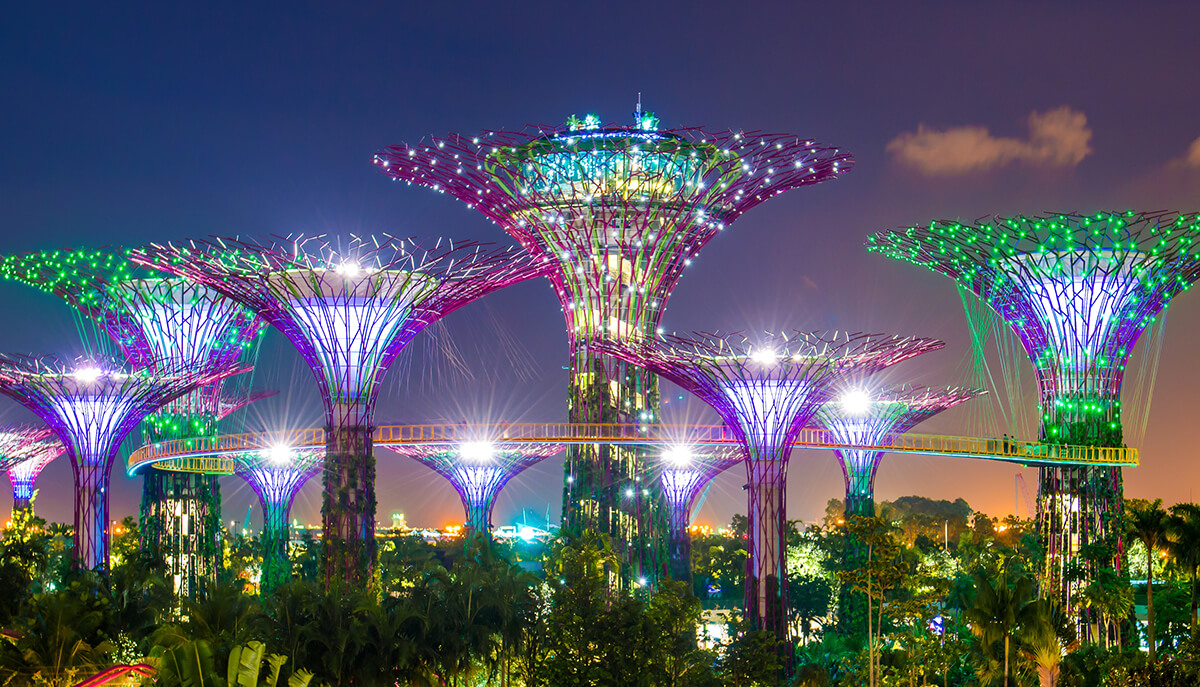
Start here, not inside the conservatories. The Supertrees—those 16-story-tall vertical gardens—are architectural statements, but they become profound in golden hour light. The sun, still above the horizon but descending, strikes the trees at an angle that reveals their structure: the metal frame becomes visible, the vertical gardens cast shadows that outline their geometry, and the entire structure feels less like a sci-fi fantasy and more like a deliberate marriage of biomimicry and engineering. Walk the outdoor paths slowly. Cross the Dragonfly Bridge and Meadow Bridge. Explore the Bay Garden East (free, open 24 hours). Take photographs from multiple angles—the trees change completely depending on whether you're shooting from below, at eye level, or from the OCBC Skyway above.
Why 5:30-6:00 PM specifically: This is the last 30 minutes of usable natural light where it's still pleasant enough to explore outdoors without melting. The crowds that arrived at 3-4 PM (during peak heat) have started heading home. You're in a rare window of being moderately crowded but not packed, with perfect light.
6:00-7:30 PM: Cloud Forest (Misting Ritual + Architectural Apotheosis)
Now enter the conservatory, specifically the Cloud Forest. This is where most tourists get it wrong: they visit Cloud Forest during daytime, when fluorescent lights supplement natural light and the entire space feels artificially lit. Evening is entirely different. By 6:00 PM, the misting occurs (it happens at 10am, 12pm, 2pm, 4pm, 6pm, 8pm daily), and the interior becomes ethereal. The 35-meter indoor waterfall—the world's tallest indoor waterfall—is backlit by diffuse natural light entering from skylights above. When the mist activates, you're literally inside a cloud, with water cascading through vapor. The photography here is extraordinary; the emotional experience is almost meditative.
Architectural note: The Cloud Forest's interior is an 11-story mountain structure with skywalk bridges spiraling around a central void. The waterfall is the pivot point. The design is deliberately recursive—you spiral upward as the waterfall cascades downward, creating a visual and spatial dialogue. In daylight, this is interesting. In evening light with mist, it becomes almost sacred.
Timing precision: Aim to be inside Cloud Forest when the 6:00 PM misting occurs. Stay for 60-90 minutes. Your departure time (7:30 PM) gives you 15 minutes of buffer before the first light show at 7:45 PM. If you want to catch the 6 PM misting specifically and photograph it, arrive by 5:50 PM.
Pro photography move: Position yourself on the lower skywalk (not the peak observation point—that's crowded and has poor backlight angles). The misting creates backlit vapor—light passing through water is luminous. Shoot toward the light source (the waterfall), not away from it.
7:30-7:45 PM: Flower Dome (Optional, Time-Permitting)
If time permits and you purchased the combo ticket, 30 minutes in Flower Dome is possible. This conservatory is less spiritually essential than Cloud Forest but horticultural- and photographically rewarding. The Dome is a glass structure showcasing plants from five continents under climate control. The interior lighting is warmer in evening (they adjust to supplement natural light loss), and the 1,000+ plant species are genuinely spectacular. However, if pressed for time, this is the attraction to skip. Cloud Forest is non-negotiable; Flower Dome is optional luxury.
Why not earlier: Daytime Flower Dome is aggressively commercial—crowded, fluorescent-heavy, and doesn't benefit from natural light the way Cloud Forest does. Evening visits are markedly emptier and feel more contemplative.
Move 3: The Light Show Positioning Strategy (Where You Stand Matters More Than When)
The Garden Rhapsody light show occurs nightly at 7:45 PM and 8:45 PM (15 minutes each). Both shows are identical in content but dramatically different in atmosphere. Here's what guides are contractually prevented from telling you: The 8:45 PM showing is superior. By 8:45 PM, families with young children have left, the casual tourists who watched the 7:45 PM show have departed, and the crowd has thinned by approximately 60-70%. The weather is also cooler by 45 minutes, and you're post-dinner rather than pre-dinner (psychology matters—people are more present when not anxious about dinner timing).
How to watch it: There are three legitimate options, and each offers something different.
Option 1: Under the Supertrees (Free, Immersive) This is the democratic option. Arrive 20 minutes before the 8:45 PM show (8:25 PM) at the Supertree Grove main plaza. Claim a spot directly under or between the trees (the 18 trees form a rough circle, and the show is choreographed around all 18). Lying on the ground or sitting on a bench, you get a 360-degree experience. The 68 surround-sound speakers create an immersive audio field. The trees light up in cascading patterns—deep purples, electric greens, warm oranges. The show is 15 minutes of pure spectacle. Why under the trees? You're essentially inside the performance rather than watching it from a distance. The emotional impact is significantly higher. Cost: Free (though entry to Supertree Grove technically requires admission; the light show itself is free).
Option 2: OCBC Skyway (SGD 20, Elevated Vantage) If you purchased the OCBC Skyway ticket (a bridge connecting two Supertrees at 22 meters height), you watch from an elevated position. The advantage is a 360-degree elevated view of all the trees simultaneously—you see the full choreography unfold rather than just the trees immediately around you. The disadvantage is that some surround-sound frequencies are lost at height, and you're slightly removed from the immersive effect. Photographers often prefer this angle. Cost: ~SGD 20 for the skyway ticket.
Option 3: Marina Bay Sands Observation Deck (Premium, Panoramic but Less Intimate) If you have access to MBS's observation deck (separate, expensive ticket—not included), you get a bird's-eye view of the entire Gardens and the glowing Supertrees with the city skyline behind them. Beautiful but distant. Audio is barely perceptible. Best for photography; worst for emotional experience.
The insider recommendation: Stand under the Supertrees for the 8:45 PM showing. Arrive at 8:25 PM. Bring a light jacket or cardigan (evening temperature drops slightly, and you'll be stationary for 15 minutes). Lie down or sit. Let the 68 speakers surround you. Experience it rather than photograph it (though capturing a few phone videos is fine).
The Unvarnished Drawbacks (So You Can Decide This Is Worth It Anyway)
Gardens by the Bay is extraordinary, but it has limitations worth acknowledging upfront.
It is genuinely crowded on weekends and public holidays. The 8:45 PM show mitigates some of this, but if you visit on a Saturday evening in late January (near Chinese New Year), you'll still encounter significant crowds. Weekdays are empirically quieter. If crowd tolerance is low, visit Tuesday-Thursday.
The conservatories are expensive for what they are. SGD 28 for Cloud Forest alone feels steep when you factor in the 1.5-2 hour visit time. The value proposition is stronger if you visit both (combo SGD 50-55). The experience justifies the cost intellectually and aesthetically, but your wallet might initially protest.
Daytime visits are legitimately punishing. If you arrive at 11 AM (common tourist time), the outdoor gardens are almost unbearable—sun exposure, heat radiating from stone/concrete, humidity making shirts cling. You'll rush through to escape the weather. Your memory will be frazzled, not contemplative. This isn't a fault of the Gardens; it's equatorial reality. But it's worth knowing that visiting midday is self-sabotage.
Photography competition is real. The Gardens' Instagram-famous status means photographers camp specific spots (Cloud Forest skywalk, Supertree angles, misting moments). If you're seeking solitude, you won't find it. If you're seeking photogenic moments, you'll be vying for positioning with dozens of others capturing the exact same shot.
The light show, while visually stunning, is brief and repetitive. 15 minutes, twice a night, same show. If you're expecting a 45-minute theatrical production, manage expectations. It's a sophisticated light and sound experience, not a Broadway show.
The Chronological Evening Protocol (Minute-by-Minute)
4:45 PM – Depart from accommodation / Central Singapore Aim to be at Bayfront MRT by 5:10 PM. This gives buffer for transit variability.
5:10 PM – Arrive Bayfront MRT, take Exit B Follow signs through Marina Bay Sands underground linkway. Air-conditioned, pleasant, 12-minute walk.
5:20 PM – Arrive at Gardens entrance You're now at the Supertree Grove main plaza or Meadow Bridge entrance. The light is still strong but descending—that golden angle is beginning.
5:20-6:00 PM – Outdoor Exploration Phase (First Golden Hour) Walk the outdoor paths. Photograph the Supertrees from multiple angles. Explore Dragonfly Lake area. Cross bridges. Get oriented to the 101-hectare space without rushing. The crowd is moderate (not overwhelming like midday, not thin like very late evening). The light is warm and directional—perfect for visual appreciation.
6:00-7:30 PM – Cloud Forest Immersion (Misting + Interior Architecture) Enter Cloud Forest conservatory. You'll arrive just as or shortly after the 6:00 PM misting occurs. Plan to spend 60-90 minutes here. Explore the 11-story mountain structure. Walk the skywalk spirals. Observe the 35-meter waterfall. The interior temperature is cool (air-conditioned), and the visual experience is superior in evening light. This is the emotional centerpiece of your visit.
7:30-7:45 PM – Optional: Flower Dome or Pre-Show Positioning If you're interested, spend 20-30 minutes in Flower Dome (1,000+ plants, five-continent showcase). If not, use this time to exit conservatory, reorient to exterior temperature, and position yourself under the Supertrees for the approaching light show. Grab water. Take a breath. This is a transition period.
7:45 PM (or 8:45 PM if you prefer) – Garden Rhapsody Light Show Watch the show. If you chose the 7:45 PM slot, crowds are higher. If you're waiting for 8:45 PM, use the hour to grab dinner at Satay by the Bay (7:00-8:00 PM) or rest under a shaded area.
8:00-8:45 PM – Dinner Window (If Doing 8:45 PM Show) Satay by the Bay is perfect here. It's 9-minute walk from Cloud Forest, waterfront seating, local food (satay SGD 9 for 10 skewers, Hokkien mee SGD 10-12, chicken rice SGD 8-10). Casual atmosphere. Finish by 8:30 PM, giving 15-minute buffer to return to Supertree Grove for the 8:45 PM show positioning.
8:45 PM – Second Light Show (or 15 minutes post-7:45 PM show) Watch the show. Lie under the Supertrees. Experience the immersive surround-sound choreography. 15 minutes of pure experience.
9:00-9:30 PM – Departure + Return Journey Exit Gardens. Return to Bayfront MRT via the same route (reverse walk through MBS linkway). Standard MRT fares to your destination. You're home by 10:00-10:30 PM depending on accommodation location.
Frequently Asked Questions (The Real Concerns Visitors Have)
Q: Is this honestly better than visiting a traditional botanical garden?
A: Fundamentally different endeavor. Traditional botanical gardens (like Singapore Botanic Gardens, which is free and excellent for morning walks) are educational, serene, plant-focused. Gardens by the Bay is architecture, theater, and photography-focused with plants as supporting players. It's not "better"—it's a different medium. If you want peace and botanical education, go to Botanic Gardens. If you want architectural spectacle and visual drama, go here. Both are worth experiencing; they scratch different itches.
Q: Is the combo ticket (Flower Dome + Cloud Forest + more) worth it over single attractions?
A: Yes. Cloud Forest alone (SGD 28) is essential. Add Flower Dome (making it SGD 50-55 combo) if you have 4+ hours—the variety justifies the cost. Skip Floral Fantasy unless you're particularly interested in immersive 4D experiences or have children. The SGD 79 three-attraction package is overkill for most visitors.
Q: Do I really need to stay 3-4 hours, or can I do this in 2 hours?
A: You can do a "2-hour sprint" (outdoor gardens 45 mins + Cloud Forest 45 mins + light show 15 mins), but it lacks the contemplative quality that makes the Gardens special. Three to four hours allows you to linger, absorb, photograph thoughtfully, and experience the tonal shifts between spaces. If genuinely time-constrained, do Cloud Forest + light show as a bare minimum (2.5 hours total).
Q: Should I do this on a weekday or weekend?
A: Weekday evening (Tuesday-Thursday) is objectively superior for experience quality and crowd management. Weekend evenings are 40-60% more crowded. If you only have weekends available, the 8:45 PM show (not 7:45 PM) is more manageable, and arriving early (5:00 PM) to beat the early-evening families helps.
Q: Is January 2026 really the best time to visit, or am I overthinking this?
A: January is legitimately excellent for the reasons outlined (post-holiday crowds, mild weather, light angles, CNY decorations starting). But "good timing" is relative. June-August are terrible (monsoon heat). March-May and September-November are decent. December is crowded (holidays). January-February is top-tier. If you can only visit once and have timing flexibility, yes—prioritize January-February.
Final Reflection: Why This Matters
Gardens by the Bay operates as a successful tourist attraction precisely because it fails to reveal its full sophistication to casual visitors. An afternoon tourist sees Supertrees and takes a selfie. An evening visitor at the right time experiences architecture that dialogues with nature, choreography that animates space with meaning, and light that transforms perception. The Gardens by the Bay that matters to architects, to photographers, to anyone interested in how design can elevate public experience—that version only exists in a 3-4 hour evening window in January through early March. You're not just visiting a garden. You're experiencing one of Southeast Asia's most intellectually coherent public spaces when it's designed to be experienced. The price, the walk, the timing—they're all worth it.